Posts

Sayyidah Zainab Bint Ali (Alihi-Salaam) – Unbroken

Introduction:-                                  In his last sermon, Prophet Muhammad (S.A.A.W) said,’ I am leaving among you two weighty things (Thaqalayn)- the book of Allah (The Quran) and my Ahle-byat (my family). If you hold fast to them, you will never go astray after me. And indeed, they will not sever until they return to me at the pond (Al-Kawthar) ( Sahih Muslim ). This tradition underlines the glorious virtues of Ahle-Byat. And Hazrat Zainab e Kubra (A.S), the blessed daughter of Hazrat Ali (A.S) and Hazrat Fatima (A.S), enjoys the reputation of being a member of this virtuous group. Early Life and Lineage:- Hazrat Zainab bint Ali (A.S) was born on 5 Jumada-al-Awwal in 5 AH (626 CE) in Medina and died on 15 Rajab in 62 AH (682 CE). Her pedigree is enough to discern her exalted stature. She is the granddaughter of Prophet Muhammad (S.A.A.W), who grew up in a house known for piety, wisdom, a...

A TEACHER EXTRAORDINAIRE - GHULAM HASSAN HAKEEM

Image
  By :- Zeeshan Rasool Khan Hum Tau Mayil Ba-Karam Hain, Koi Sayal Hi Nahin Rah Dikhlaen Kise Rahraw-e-Manzil Hi Nahin - ( Allama Iqbal) (We are inclined to Mercy, but there is no one to implore: Whom can we show the way when there is no traveler?) This verse from Allama Iqbal’s Jawab-e-Shikwa would often reverberate in the morn wind of our high school - Hanfia Islamic Educational Institute Seer Hamdan, after our beloved teacher - Ghulam Hassan Hakeem, would appear on the podium behind the wired microphone. Then knowledge-filled, intellectually rich lectures and invaluable advice would follow. His articulation, eloquence, and knowledge would captivate every listener. The profuse use of English proverbs and phrases, along with Urdu and Persian poetry, and citation of events from Islamic literature distinctly reflected his erudition. Ghulam Hassan Hakeem, our English teacher at Hanfia Islamic Educational Institute, served to impart knowledge for decades with the utmost sincerity and ...

Rashat e Khamah (Majmua Mazameen)

Image
By : Dr. Shakeel Shifayi Reviewer : Zeeshan Rasool Khan      While we lament the misuse of social media, fact-check its news feeds to ensure cred, and alert people about possible vulnerabilities it can bring, we have scores of people who have made it a medium of information, awareness, and knowledge. Well-known scholar, educationist, writer, and Urdu lecturer Dr. Shakeel Shafayi is a leading technophile who has engaged netizens through his entrancing ideas, which over time have been gathered in the form of a book titled Rashat e Khamah. Rashat e Khamah, meaning ‘writings from pen’, is originally a collection of Dr. Shifayi’s Facebook posts well-liked by his audience. The book spans over 271 pages and is divided into six parts. Starting with personalities, it covers literature, Islamic studies, events from the scribe’s diary, contemporary issues, and accounts of the writer’s trips. Each segment is laden with loads of knowledge, instructions, and constructive proposals...

Kafkaesque and the Man behind it!

Image
  Sometimes conditions do not favour you and everything goes wrong in your life. You fail to measure up to the expectations of the people. You want to live the life of choice but aren’t allowed. You are expected to fit in the norm set by others’ and your personal preferences are not valued. The things you like with every fibre of your being are unappreciated by society and your parents. There comes a time when you become an object of ridicule to everyone. Your worth and credentials are questioned. You are considered nothing more than a burden. Overall, the things around you change for bad and you find yourself in a deep dark tunnel with no end. You, however, don’t lose the game of life rather you enter into Kafka’s world — wherein enduring pain is only the way to exist even after death. Franz Kafka is a well-known, even the greatest, German writer of the 20th century. He is enlisted among those writers who got accreditation posthumously. Writing about the most neglected part of the...

MOLANA MUSHTAQ AH KHAN — THE GREAT SUFI POET.

Image
                                         Some people leave this world only after leaving an undying legacy behind them. Things around us disappear or change constantly, even our ideas, perspectives, likes, and dislikes witness variation; nevertheless, their ideology survives. Their footprints invite others to follow them. Liking and admiration for them surges with time and memories attached to them do not fade. Molana Mushtaq Ahmed Khan Sahb (1952–2019) is one such personality whose vision, mission, and passion live on to influence people. He was a Sunni scholar, persuasive orator, poet, educationist, and Sufi. Influenced by scholars like Allama Syed Qasim Shah Bukhari and seers like Ali Bab Sahib, Molana dominated the religious landscape of the valley for nearly four decades. His journey started as a teacher from the village of Seer Hamdan Anantnag and culminated after touching the ...

Virtual and Real aren't the same !!

Image
 Zeeshan Rasool Khan Social media is a powerful tool of communication and information. Social media includes Facebook, YouTube, WhatsApp, and X - formerly Twitter. These potent platforms enable people from different areas, states, and countries to connect. It allows people to share thoughts and express themselves. Social media has been effective in bringing tremendous transformation throughout the world. Its role in socioeconomic, religious, and political aspects of the world is uncontestable. Nonetheless, just like every other thing social media has a negative facet and possesses drawbacks ranging from security issues to the spread of misinformation. Besides these, there are some other problems related to it. One of which is associated with the personality of a person. Social media impinges on our individuality. On social media, particularly Facebook, WhatsApp, and X, we often compromise our selfhood. We lose our identity to the virtual community. And this takes us away from ‘ou...

MAKING SHRINES LEARNING CENTERS

Visiting Shrines - paying obeisance, and tribute to saints, is ingrained in the Kashmiri society. Although, different religious schools of thought disagree on this matter, yet majority of Muslims believe shrine visiting is a blessed and spiritually-boosting activity. Some people throng shrines not only for spiritual reasons but also to enlighten themselves with knowledge. Knowledge - regarding the saints, their lives, worship, struggles, contributions, and miracles. Being the inhabitant of an area that is close to the shrines of two grandees, disciples of Sheikh Noor-ud-din Noorani (R.a) viz; Hazrat Zainuddin Reshi (R.a), and Hazrat Baba Bammudin Reshi (R.a), situated at Aishmuqam and Bumzoo Mattan respectively, I occasionally do pay a visit to these places. At Zainuddin Wali's Shrine, which regularly witnesses a gargantuan influx of devotees and visitors, I encountered many devotees so far who wanted to know about the Saint to explore his life. But every time, I saw them being f...

CELEBRATE WITH PURPOSE

Image
  Zeeshan Rasool Khan Rabi-ul-Awal is an auspicious month of the Islamic Calendar, for the Prophet Muhammad (pbuh) was born in this month according to the most credible opinion. Though 12th Rabi-ul-Awal is celebrated as the Mawlid (birthday) of Prophet Muhammad, however; the celebrations continue throughout the month. Among Muslims, there are a few sects that disapprove of its celebration, but the majority observe it globally. Those not celebrating it consider it innovation. Many among them disagree with the way of celebration and don’t negate it wholly. They think that Mawlid itself is not impermissible but the activities involved make it so. Also, there is no denying that in certain places, people have introduced some questionable elements to this festival that call it into question. However, if undesirable things are shut out and this event is commemorated purposefully, it can prove to be significant from several perspectives. It will be favorable in achieving many religious and...

KNOW YOUR GREATS !

Image
  HAZRAT SAYYID HAFIZULLAH ANDRABI SAHIB (R.A) After Prophet Muhammad (pbuh) and his companions, his descendants, who came to be known as Sayyids, went to great pains to disseminate the message of Islam. They left their native places and travelled to different parts of the world to continue the mission of ‘dawah’. Some settled far away from their birthplaces and later their progeny took surnames based on the places they originated from. It gave rise to various branches of the Syed dynasty like Hamdani, Bukhari, Andrabi etc. emerging from Hamdan of Iran, Bukhara of Uzbekistan, and Andrab of Iran respectively. In Kashmir, the history of Andrabi Sayyids is as old as its Islamization. Available records reveal that a devout Muslim Sayyid Ahmad Andrabi and his son Sayyid Muhammad Andrabi accompanied Mir Syed Ali Hamdani when he visited the valley of Kashmir during the reign of Sultan Qutub-ud-Din -775-792.A.H./1373-89A.D. On the directions of Syed Ali Hamdani, the father and son sta...

BOOK REVIEW – NOOR’E DIL

Image
 (Biography of Ameer’e Shariat Syed Muhammad Qasim Shah Bukhari- R.a)  By : ZEESHAN RASOOL KHAN A great Sunni scholar, Sufi, preacher, writer, journalist, and visionary leader Allama Syed Qasim Shah Bukhari (1910–2000) is one of the far-famed religious personalities of our valley. Even after decades of his death, he stands out to be peerless in all facets. Consequently, those who know him mention him with reverence and those not knowing desire to know him. For that reason, he has always been part of the research, intellectual conversations, and religious discourses and this is going on. Soon after his departure, his disciples, students, associates, and well-wishers expressed their opinions to pay tribute to their mentor. All those were recorded and published by Anjuman Tableegul Islam in its special edition of the official organ Monthly Al-Aetiqaad - Allama Bukhari Number (Feb. 2001). After that, Bukhari's student, a walking-encyclopedia, Molana Showkat Hussain Keng authored h...

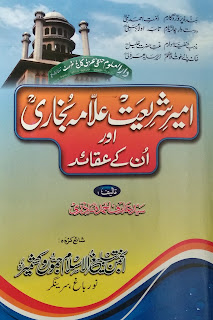
BOOK REVIEW AMEER’E SHARIAT ALLAMA BUKHARI aur UN KAY AQAID

Image
 AMEER’E SHARIAT ALLAMA BUKHARI aur UN KAY AQAID Author : SYED ARIF AHMAD QADRI  Review by Zeeshan Rasool Khan Syed Muhammad Qasim Shah Bukhari (1910-2000), (President of Anjuman Tableegul Islam 1960-2000) was an illustrious religious scholar, writer, preacher, journalist, and social activist who colossally contributed to the spread of Islam in Jammu and Kashmir. Syed Qasim Shah Bukhari wrote more than a hundred books on various subjects of Islam. Besides translating and interpreting Quran in Urdu and Kashmiri, he translated literary works of great Sufi scholars cum saints like; Mir Syed Ali Hamdani (R.a), Baba Dawud Khaki, etc. He established Hanafi Arabic College in the heart of Srinagar city. He traveled far and wide with a vision of educating the masses. For that, he successfully started religious seminaries and English medium schools in the length and breadth of the valley. Under his leadership historical religious gatherings took place in every nook and corner of the v...

Ameer’e Kabeer : The Guiding Light

Image
Ameer’e Kabeer Hazrat Mir Sayyid Ali Hamdani (R.a) was a celebrated Islamic scholar, a preacher, a poet, a writer, an ascetic, and a spiritual leader of the Kubrawiya Sufi Order. He was born in Hamadan (Iran) on 12 Rajab 714 A.H. and died on 6th Zilhajj in 786 A.H. and was entombed in Khatlan (Tajikistan). Sayyid Ali’s father Sayyid Shahabuddin Hamdani (R.a) and his mother Sayyida Fatima (R.a) were descendants of Prophet Muhammad through his grandsons Imam Hussein (A.s) and Imam Hassan (A.s) respectively. They were pious souls known for their piety, God-consciousness, and self-discipline.  Sayyid Ali started his education career at his home. He was tutored by his maternal uncle Sayyid Ala-ud-din. His spiritual instructor was Shaykh Sharfuddin Muzdaqani. Later, Shaykh Muzdaqani entrusted him to Shaykh Taqi-ud-din Ali Dosti for further training. After completing the task of discipleship successfully, his chief mentor Shaykh Muzdaqani ordained him to travel through the l...